Ireland--Limerick (City)

Elements area

Taxonomy

Code

Scope note(s)

    Source note(s)

      Display note(s)

        Hierarchical terms

        Ireland--Limerick (City)

          Equivalent terms

          Ireland--Limerick (City)

            Associated terms

            Ireland--Limerick (City)

              21 Archival description results for Ireland--Limerick (City)

              21 results directly related Exclude narrower terms
              IE 2135 P4 · Fonds · c. 1812-1859

              The material contains primarily correspondence, petitions and resolutions created and generated by Thomas Spring Rice during his political career.

              Untitled
              The Jim Kemmy Papers
              IE 2135 P5 · Fonds · 1863-1998 (predominantly 1962-1997)

              Membership lists, correspondence, account books, financial reports, minutes, statements and press releases relating to The Ancient Guild of Incorporated Brick and Stonelayers’ Trade Union, Woodworkers and Plasterers’ Trade Union, Construction Industry Federation, Irish Congress of Trade Unions, Limerick Building Trades Group, SIPTU and other trade unions and union activities (1962-1998); rules, correspondence, bills, receipts and financial reports relating to the Mechanics’ Institute (1882-1996); constitutions and policy statements, press statements, speeches, membership lists, minutes, financial statements, election manifestos, correspondence, pamphlets and posters relating to the Democratic Socialist Party (1980-1994); minutes, reports, statements, accounts and correspondence relating to the Labour Party (1965-1997); electoral material and correspondence relating to Kemmy’s Dáil terms and electoral campaigns (1977-1997); correspondence, speeches, press releases, minutes and appointment diaries relating to Kemmy’s activities as Alderman and Mayor (1974-1997); appeals, petitions and other correspondence relating to Kemmy’s constituency work (1967-1997); articles and draft articles, research material (including nineteenth-century documents) and correspondence relating to Kemmy’s historical and literary activities; and photographs, artwork, correspondence and a small number of other items of personal nature.

              Untitled
              IE 2135 P29 · Fonds · 1722-1840, c. 1858-c.1902, c. 1960s, 1973, 2024

              The collection comprises primarily letters and copies of letters by members of the Monsell family or individuals associated with them. Of particular note is a letter book kept by the shipping merchant William Monsell (P2/1/1), which contains copies of some 1,200 items of mainly business correspondence, giving a unique insight into Limerick as a maritime mercantile city in the early eighteenth century. Of equal interest is the fragment of a diary (P2/1/12) kept by his grandson, the Reverend Samuel Monsell (1743-1818), Precentor of Ardfert from 1791 to 1811, which provides an extraordinary account of the private life and innermost thoughts of a Church of Ireland clergyman struggling to stay on the path of virtue.

              Untitled
              IE 2135 P101 · Fonds · 1854-1904 (predominantly 1870-1888)

              This collection contains correspondence, accounts and other documents concerning the leasing of Mungret Agricultural School by its trustees to the Commissioners of National Education in 1853; the subsequent closure of the school and surrender of the lease back to the trustees in 1878; the parliamentary bill required to allow the trust fund to be redirected for broader educational purposes; and the subsequent lease of the school to the Reverend Joseph Bourke 1880 and to Father Ronan in 1882. The material provides an interesting record of the legal and administrative complications affecting the operation of the school and its gradual shift from an agricultural school to a Jesuit apostolic school and lay secondary school.

              Untitled
              The Limerick Papers
              IE 2135 P51 · Fonds · 1531-c. 2019 (predominantly 1832-1913)

              The main portion of this collection consists of wills, accounts, correspondence and statements from the mid- to late nineteenth and early twentieth centuries relating to the family’s financial affairs, mostly arising from the will of the 1st Earl of Limerick and the dramatic reduction in rents at the turn of the century, which necessitated the sale of holdings through the Land Commission Court in the early 1900s. There is a small but interesting series of leases of property in Limerick City (P51/3/1/1-3 and P51/4/1-2) and a comprehensive set of documents (P51/3/2/1-28) relating to a dispute over title to St George’s Church at No. 1 Mallow Street, Limerick, which was demolished to make way to the Provincial Bank of Ireland, designed by James and George Richard Pain (for a ground plan of the bank by the Pain brothers, see P51/3/2/11).

              While much of the early material relating to the Earls of Limerick and their antecedents is deposited in the National Library of Ireland, some interesting early documents can also be found in this collection. Of particular note is a compilation of manuscript transcripts of letters and petitions (P51/1/1) by Edmond Sexten the elder (1486-1555) and his grandson Edmond Sexten the younger (1595-1636) concerning among other things their disputes with Limerick Corporation. The document is written in secretary hand, but a more easily legible version can be found in P51/1/2. Also worth noting is a compilation of abstracts and copies of early deeds relating to the Sexton, Casey and Stackpole families (P51/1/3). A wonderful example of the emergence of the Age of Enlightenment can be found in P51/2/1 in the shape of a commonplace book, in which Colonel Edmund Pery kept notes between 1671 and 1681 on weights and measures, foreign coins, chronology, geography, astronomy, orthography, pronunciation and usage of English, significance of colours, instructions concerning the keep of horses, recipes for ink, boot polish etc., gardening activities and meteorological predictions.

              A shortcoming of this collection is its limited scope. There are no rent rolls, no estate correspondence and no personal correspondence of family members. The building of Dromore Castle remains unrecorded, except for a scrap book (P51/5/4/1) compiled in 1868-1869 to contain sketches by the architect Edward William Godwin and rare photographs of Dromore Castle taken at various stages of its construction and a sketch of fireplace tiles by Godwin (P51/5/4/2). The only item of personal nature in the collection is an album of photographs, sketches, and signatures collected by May, Countess of Limerick during house parties (P51/6/3/2/2).

              It should be noted here that the material deposited in the National Library of Ireland dates primarily from 1371 to 1806. A significant gap of the nineteenth-century material therefore exists, both in terms of estate and personal documentation.

              Untitled
              IE 2135 P97 · Fonds · 1809-1852

              This collection contains a client ledger and separate index from Sir Matthew Barrington's legal firm in Limerick city, providing names of clients and details of the legal affairs in which they were involved. The ledger, originally part of a multiple set of volumes, is of considerable historical interest in view of the distinguished client list, which includes both nobility and prominent merchants, and the level of detail provided of their legal affairs.

              Untitled
              The Daly Papers
              IE 2135 P2 · Fonds · c. 1790s-2017 (predominantly 1877-1975)

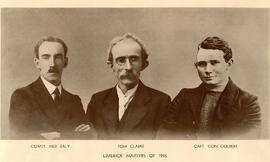
              The Daly Papers provide a unique insight into the birth of the Irish republic and the country’s search for an identity in the first decades of its existence. At the core of the collection is material relating to John Daly, a prominent Fenian and a source of inspiration to the generation that followed, as attested by the quantity of correspondence from numerous prominent republicans of the time. Of particular note is Daly’s correspondence with Thomas Clarke (P2/2/1/11/1, 3, 5 and 6; P2/2/1/18/9-21, 23-27 and 29-30). Other items of note include Seán Mac Diarmada’s account of his part in the Howth gun-running operation (P2/2/1/31/8); Edward (Ned) Daly’s last letter to his mother on the eve of the Easter Rising (P2/2/1/17/2); and Kathleen Clarke’s letters to her sisters during her imprisonment in 1918-19 (P2/2/1/10/4-10). The latter also illustrate the role of women in the formation of the Irish republic, as do several other items of correspondence in the collection. Madge Daly’s draft memoirs (P2/2/2/2/1-5) provide a first-hand account of the events leading up to and immediately following the Easter Rising. Her account of a visit to Kilmainham Jail to see her brother Edward (Ned) Daly prior to his execution (P2/2/2/3/1) offers a unique insight into the hardship suffered by the families of the leaders of the Easter Rising, and added poignancy is provided by personal effects in Ned’s possession which were returned to the family after his death (P2/4/1/3). The large volume of photographs contained in Series 6 provides further insights into the main players of this most turbulent of times.

              Material relating to the Dore branch of the Daly family opens a window into the young nation’s first steps as an independent state. Of particular interest are Edward Dore’s military medals (P2/4/3/1-4) and his determination to commemorate the Easter Rising in Limerick City which resulted in the erection of a memorial on Sarsfield Bridge in 1956 (P2/2/1/60/6/2, P2/3/1/3/1/1-4, P2/5/1/41 and P2/6/8/5-9); and his son Éamonn de hÓir’s impassioned campaign for the promotion of the Irish language (P2/3/2/3/3/1-14) and his extensive contribution to the study of Irish place names (P2/3/2/3/2/1-20). Also of note is de hÓir’s substantial research into the life of John Daly (P2/3/2/3/5/1-3 and P2/5/1/61-65) with a view to writing his biography, the publication of which was prevented by de hÓir’s untimely death.

              The collection of letters and artefacts in the possession of the Daly family was originally considerably more substantial but the burning of their home in 1921 by the British Army destroyed much valuable material (see P2/2/1/19/3, P2/2/1/60/3/3, P2/2/1/62/5, P2/4/1/7 and P2/5/1/40). Records relating to the Daly family’s bakery in Limerick City are superficial, comprising mainly account books from Edward Dore’s time as manager. The fate of the papers relating to this business is unknown.

              Untitled
              IE 2135 P39 · Fonds · 1967-1976

              Bound hardback Collins Balmoral Series account book containing on pages 1-9 and 332-354 minutes of the annual general meetings of the Mid-Limerick Brigade of the National Association of Old IRA between 17 January 1965 and 5 February 1976 and on pages 11-165 minutes of their monthly, special and extraordinary meetings held between 2 March 1967 and 1 January 1976, pages 10 and 166-331 being blank. Interspersed with the monthly meetings are also intermittent minutes of the Dinner Dance Committee.

              The meetings took place at the Mechanics Institute [Hartstonge Street] in the mid-1960s, in the Clare Chambers [10 O’Connell Street] from October 1969 and at the Transport Union Hall at 91 O’Connell Street from April 1973. Occasional meetings also took place at the Gaelic League Hall on Thomas Street. The primary purpose of the annual general meetings was the election of officers. At the 1970 annual general meeting a decision was made to rotate the chairmanship annually; however, just two years later, after the particularly successful chairmanship of Tom Dargan, the resolution to bar a chairman from seeking re-election was rescinded.

              The general monthly meetings revolved around preparations for special events such as St Patrick’s Day parade, Easter Rising commemorations and the annual dinner dance and social. In 1965, a committee was formed between the Old IRA and Sinn Fein to organise an Easter parade. As Sinn Fein objected to carrying rifles through the streets or at the graveside, a decision was made that ‘for the sake of unity… the Rifles should be left aside for the Parade’ (AGM, 17 January 1965). In 1969, a debate began on whether members should revert to carrying their rifles. As no decision could be made on the subject, it was eventually decided that the Army should take over as a firing party at Old IRA funerals (5 October 1972).

              The needs of members also played a central role. At each meeting, the names of deceased members or deceased relatives of members were read out and masses organised in their honour. Condolences were sent to grieving families and financial assistance was organised for those who struggled to carry the cost of funeral expenses. Hospital visits were made every Christmas to deliver gifts to hospitalised members. The committee also assisted with applications for pensions, service medals, free travel cards and other forms of financial assistance. In 1970, the committee complained to the Department of Defence that ‘the peak hours which prohibited [free] Travel Card holders on City Bus Services was too long’ (1 February 1970). In the same year, they unsuccessfully sought an increase in free electricity allowance (1 April and 3 June 1970).

              Although the Organisation avoided becoming involved with Irish politics, it by no means remained immune. In 1971, it made a resolution to ‘ask the Government to resist completely the present attempt by American Carriers to secure landing rights in Dublin and continue to afford Shannon & the mid West the opportunity of continued development and posterity [sic]’ (4 November 1971). In 1974, two visiting members of the Anti-Internment Committee attended the monthly meeting, as a consequence of which a resolution was adopted that ‘we are opposed in principal to the internment of civilians without trial… [and] that internment in Northern Ireland now 3 years in operation is both a continuing cause of violence & a primary obstacle to the success[ful] call of the immediate release of all internees’ (7 November 1974). Advantage was also taken of the changing of the political guard. In 1970, when the committee’s petition for free travel for the wives and widows of Old IRA members was rejected by the Minister for Defence, they turned to the newly appointed Minister for Justice, Desmond O’Malley, to see if he could make it happen (1 October 1970).

              Commemoration played an important part in the Organisation’s activities. They contributed to the Limerick Memorial fund, the purpose of which was to erect a monument on Sarsfield Bridge to honour those who died in the Easter Rising and attended the unveiling in great numbers. Although ‘ranks had been broken at conclusion of march’ and ‘there were complaints too regarding seating accommodation’, the unveiling was deemed a great success (AGM 3 February 1972). In 1970, the Organisation campaigned for a special stamp to be issued to commemorate the murders of Michael O’Callaghan and George Clancy, Mayors of Limerick in March 1921 (3 December 1970, 25 February 1971). The news of the death of Éamon de Valera was received with due decorum. All present stood in silent prayer as a mark of respect, the Chairman paid tribute to his memory and ‘recalled de Valera’s meeting with the Old I.R.A. in Limerick just after the Truce in 1921’ (2 October 1975).

              What dominates the minute book is the steadily increasing number of condolences to bereaved families of deceased members. Already in 1966 the honorary secretary noted how ‘the ranks were getting thinner & thinner every year and that for the year that had passed a lot of our members had gone to their eternal reward’ (3 March 1966). In 1975, by which time meetings had moved to a room in the Transport Union Hall, some members ‘considered the stairs climbing a bit strenuous’ and requested ‘that the Chairman & Secretary see Union Officials with a view to getting a Room nearer the basement’ (6 February 1975). The minute book thus serves as a poignant record of the increasing frailty and gradual fading away of the generation who fought for Irish freedom.

              Untitled
              The Michael O'Toole Papers
              IE 2135 P76 · Fonds · 1975-2005

              This collection contains documents collected and accumulated by Michael O’Toole while compiling a bibliography of works by Kate O’Brien and works written about her. The material includes interview notes, correspondence, writings, draft bibliographies, photographs and ephemera.

              Untitled
              The Lilburn Papers
              IE 2135 P11 · Fonds · 1864-2005 (predominantly 1930-1979)

              This collection contains a diverse range of records relating to the Lilburn family of Limerick city. The first part contains material created and generated by the accountancy firm of Metcalfe, Lilburn and Enright, illustrating the growth and development of the company from the 1920s to the 1970s. The client files show the practice to have been the leading Protestant accountancy firm in the city, with clients such as Adare Tobacco Manufacturing Company established by the fourth Earl of Dunraven in the early 1900s. The second part consists of personal records of the Lilburn family, predominantly relating to the education and hobbies of Hugh Lilburn and his son Stewart Lilburn. Of particular note is a set of personal account books which provides useful insights into middle class household economy from the 1920s to the 1970s. Also of interest are the minute books of the North Munster branch of the Irish Hockey Union from 1901 to 1941. The third part comprises records of the Limerick Presbyterian Church, mostly created by Stewart Lilburn in his role as Honorary Secretary in the 1960s and 1970s. This part also contains a copy of Hugh Lilburn’s book Presbyterians in Limerick (1946) and a subsequent reprint (1959). Together, these three parts provide a valuable cross-section of all aspects of the lives of three generations of a well-to-do Protestant middle-class family in twentieth-century Limerick.

              Untitled