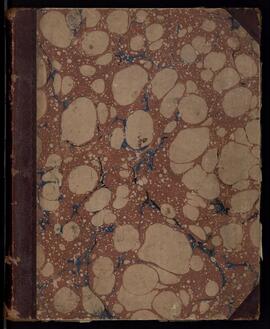
This collection comprises a scrapbook compiled by Agnes Mary Gaffney and a number of loose items found inserted inside it. It provides insights into the life and lifestyle of the members of a prominent and politically influential Roman Catholic family and their role not only in the formation of the Irish republic but on the wider arena of Irish-American republicanism and the campaign for women’s rights.
UntitledThe material contains primarily correspondence, petitions and resolutions created and generated by Thomas Spring Rice during his political career.
UntitledPair of late Victorian and early Edwardian scrapbooks in Winona Barrington’s possession, containing manuscript poems and ditties, pen and ink drawings, watercolours and autographs.
UntitledThe collection comprises primarily correspondence between Frank Aiken, IRA Chief of Staff; Mr McAuliffe Acting Officer Commanding Limerick Brigade IRA; and Maurice Twomey Inspecting Officer. They are almost solely concerned with the reorganisation of the IRA command structure in Limerick, Clare and Kerry owing to the shortage of men and equipment during and following the Civil War.
UntitledBound hardback volume containing a diary kept sporadically by Henry William Massy as a young man about town, describing his professional and leisure activities and containing introspective reflections of his own shortcomings. The diary provides a lively and betimes poignant account of the life of a young man eager to advance in life but not quite possessed of the maturity to fulfil his ambitions. It provides glimpses of urban life of the professional classes in 1830s and 1840s Ireland and challenges the perceived rigid morality of the Victorian era by revealing Massy’s long-standing clandestine affair with Maria Cahill.
The diary commences in February 1839 with regular entries describing the weather, Henry’s daily professional and leisure activities, the books he is reading, the parties he attends and the visits he pays to his mistress, Maria Cahill. He castigates himself for his habit of getting up too late in the mornings, usually as a consequence of too much merriment the night before, and for smoking cigars in his office. However, most of his diary entries are upbeat and humorous in tone. On 15 March 1839 he mentions meeting ‘Mrs James Sadleir, who asked me to subscribe to a Lying-in-Hospital, which they are getting up here – I said I did not think gentlemen had anything to do with it – she said she wished I could prove that, if so I ought to take out a patent’. His mother and siblings feature regularly on the pages of his diary, as does a destitute uncle for whom a subscription is arranged among relatives to provide for him: ‘altogether we will make up £70 a year but my uncle says it w[oul]d not keep him in potatoes & salt – How many curates live on £75 a year!’ There is a gap in the diary entries between 11 April 1839 and 19 October 1840, which Henry attributes to his lazy habits: ‘I am beginning to know myself pretty well and alas! I must confess the great fault in my character is irresolution of purpose and insuperable indolence.’ He confesses to having entered as a law student two years previously, ‘determined to read diligently… and I did keep my resolution excellently for – a week!! – since then I have done nothing’. An entry dated 23 October 1840 is followed by a blank page and a page torn out.
Henry resumes the diary in January 1841 with a description of preparations for a dinner party he is about to give and an account of the dinner party itself. He mentions his appointment to the Commission of the Peace for County Limerick and provides a lively account of a meeting he attends in Dublin on 21 January 1841 advocating the introduction of railroads in Ireland. He describes in some detail ‘Ireland’s great men’ who spoke at the meeting, including the Archbishop of Dublin, the Duke of Leinster, Earl Mountcashell, John O’Connell MP, Colonel Edward Michael Connolly, Christopher Fitzsimon MP, Henry Grattan and William Torrens McCullagh. He describes his daily activities in Dublin, which in the main consist of reading Sir Archibald Alison’s History of Europe in the Dublin Library, wining and dining at the Queen’s Inn and the Oyster Tavern, writing poetry and visiting his mistress. On one occasion, he spends half an hour walking with a Miss Millet, ‘a very agreeable girl and handsome by Candlelight’. Returning to Limerick in February, he takes great delight at the reception of some comic verse he has published anonymously. He attends the petty sessions in Limerick city as chairman for the first time ‘and went thro’ the business very well’. In March 1841, he contemplates his relationship with his mistress. ‘Poor Maria! I feel that I love her much and I know not how I can ever desert her – I have often been thinking latterly of retiring from the world with her, and taking a cottage in some retired country, of spending the rest of my days in quiet, giving myself up to my little children & my books…’ In the same month he mentions his election as president of the Mechanics’ Institute and discusses his plan to introduce a new system at the court house ‘By occasional levity and by inflicting an equal punishment on rich and poor’. He is suffering from an undisclosed ailment which is slow to heal and which leaves him ‘generally sad and out of temper’. In early April 1841 he travels to London and spends two weeks mostly dining at Lincolns Inn and visiting various theatres. Returning to Dublin, he notes: ‘I think I may in time become a useful magistrate and have a pretty fair knowledge of my duties as such – There are gentlemen on the Tipperary Bench of many years standing and, God knows! They know little enough’.
There is another long gap in entries between 2 May and 1 October 1841, when Henry describes a weekly meeting of Poor Law Guardians. An entry made on 3 October is incomplete as a consequence of a page having been torn out. The next and final entry is dated 1 January 1842, in which Henry reflects on the less flattering aspects of his character and his lack of application to qualify for the bar or to finish a story intended for publication in Blackwood’s Magazine. He also reprimands himself for the sorry state of his finances: ‘Every one, who spends more than his income, is a fool’. The entry ends abruptly with yet another torn-out page. Pagination up to page 55, but with irregularities.

UntitledThe collection consists of manuscript and typescript biographical accounts of Volunteers and civilians who died during the War of Independence and Civil War and who had links with the West Clare Brigade IRA. The accounts provide detailed information concerning the birth, early education and military career of each individual.
The collection illuminates a turbulent period in Irish history stretching from the later decades of the nineteenth century until the end of the Civil War in 1923. The inclusion of biographical details of Volunteers who were killed during the Civil War while fighting on the anti-Treaty side makes it historically significant, as information of this nature was rarely recorded.
UntitledThe main portion of this collection consists of wills, accounts, correspondence and statements from the mid- to late nineteenth and early twentieth centuries relating to the family’s financial affairs, mostly arising from the will of the 1st Earl of Limerick and the dramatic reduction in rents at the turn of the century, which necessitated the sale of holdings through the Land Commission Court in the early 1900s. There is a small but interesting series of leases of property in Limerick City (P51/3/1/1-3 and P51/4/1-2) and a comprehensive set of documents (P51/3/2/1-28) relating to a dispute over title to St George’s Church at No. 1 Mallow Street, Limerick, which was demolished to make way to the Provincial Bank of Ireland, designed by James and George Richard Pain (for a ground plan of the bank by the Pain brothers, see P51/3/2/11).
While much of the early material relating to the Earls of Limerick and their antecedents is deposited in the National Library of Ireland, some interesting early documents can also be found in this collection. Of particular note is a compilation of manuscript transcripts of letters and petitions (P51/1/1) by Edmond Sexten the elder (1486-1555) and his grandson Edmond Sexten the younger (1595-1636) concerning among other things their disputes with Limerick Corporation. The document is written in secretary hand, but a more easily legible version can be found in P51/1/2. Also worth noting is a compilation of abstracts and copies of early deeds relating to the Sexton, Casey and Stackpole families (P51/1/3). A wonderful example of the emergence of the Age of Enlightenment can be found in P51/2/1 in the shape of a commonplace book, in which Colonel Edmund Pery kept notes between 1671 and 1681 on weights and measures, foreign coins, chronology, geography, astronomy, orthography, pronunciation and usage of English, significance of colours, instructions concerning the keep of horses, recipes for ink, boot polish etc., gardening activities and meteorological predictions.
A shortcoming of this collection is its limited scope. There are no rent rolls, no estate correspondence and no personal correspondence of family members. The building of Dromore Castle remains unrecorded, except for a scrap book (P51/5/4/1) compiled in 1868-1869 to contain sketches by the architect Edward William Godwin and rare photographs of Dromore Castle taken at various stages of its construction and a sketch of fireplace tiles by Godwin (P51/5/4/2). The only item of personal nature in the collection is an album of photographs, sketches, and signatures collected by May, Countess of Limerick during house parties (P51/6/3/2/2).
It should be noted here that the material deposited in the National Library of Ireland dates primarily from 1371 to 1806. A significant gap of the nineteenth-century material therefore exists, both in terms of estate and personal documentation.
UntitledThe papers in the collection relate mainly to the Sandville branch of the family and mostly to the activities of James Grene Barry (1841-1929). They include early twentieth-century notes on family history, possibly compiled by James Grene Barry who was known for his antiquarian interests. The notes trace the history of the Sandville and other branches of the family to Elizabethan times and include much interesting material, such as handwritten copies of leases, mortgages and other documents, and pedigrees of the Barry and other families.
James Grene Barry’s political activities are recorded in a series of documents relating to his objection to Gladstone’s Home Rule Bill of 1893. Of particular interest is a letter from James Alexander Rentoul, MP for East Down, outlining his plans to canvass Grand Jury members across the country against the Bill (P20/2/7).
Administrative records in this collection relate in the main to the Sandville branch Barrys. They are mostly concerned with the family’s financial affairs and also provide an interesting insight into Land League activities in county Limerick at the turn of the twentieth century. One of the few items relating to the Standish Barry branch of Leamlara is a ledger of farm accounts kept by Henry Standish Barry (P20/3/1/1/6).
Another set of documents reflects the professional activities as estate agents of James Grene Barry and his son James Thomas Barry, and the effects on local landowning families of the various Land Acts passed in the early twentieth century. Of particular interest are items relating to the purchase of land from Henry Lyons of Croom Castle (P20/3/2/1/1-9), and the sale of part of the Islandmore estate by Major Roche Kelly (P20/3/2/2/1-2).
Finally, the collection contains deeds and a draft will relating to the Shine family of Coolyhenan, county Limerick, many of whom served as Justices of the Peace for county Limerick in the late nineteenth century. The reason for their presence among the Barry papers has not been ascertained.
UntitledPreliminary and draft manuscripts with edits, finisehd manuscripts and stencils (copies for choir members) of de Regge’s musical compositions.
UntitledThis collection contains material created and generated by the Armstrong and Kemmis families during their ownership of Moyaliffe House, county Tipperary, and includes both administrative records and personal documents. Seventeenth-century material is scarce and limited in the main to leases of small pockets of land in counties Tipperary and Limerick. A more unusual item from this period is the satirical manuscript poem On the Bill of Conformity (P6/2137), attributed to Henry Hall, one of only sixteen known copies in the world. Eighteenth-century administrative records are mainly of financial and legal nature and arise from the badly managed affairs of William Armstrong (1704-1768), which affected his brother, the Reverend John Armstrong, who succeeded to the estate. Of personal items, the collection of early eighteenth-century sermons (P6/375-P6/427) attributed to the Reverend Edward Armstrong, the Reverend John Armstrong and others is of particular interest.
The nineteenth-century administrative material relates predominantly to the management of the Moyaliffe estate, and the succession to and management and eventual disposal of the family’s estates in Mayo and Sligo. There are also some clerical records of interest, most notably material relating to tithe wars of the 1830s (P6/758-P6/766 and P6/789-P6/813), and the state of dilapidation of the Mansion House of the See of Tuam discovered after the death, in 1819, of the Most Reverend Honourable William Beresford, first Baron Decies, Archbishop of Tuam, whose daughter Catherine was married to the Reverend Willam Carew Armstrong (1791-1847) (P6/850-P6/860).
By far the most voluminous, and perhaps the most interesting, part of the collection is that relating to the twentieth century. The administrative records in this section are in the main concerned with the management not only of Moyaliffe House but also of Ballinacor, county Wicklow, home of Captain William Daryl Olphert Kemmis. There is also a large quantity of material relating to Moyaliffe Stud (P6/1547-P6/1595), and to the problem of succession to the Moyaliffe and Ballinacor estates following Captain Kemmis’s death without issue in 1965 (P6/1812-P6/1834). On the personal side, the extensive correspondence of Rosalie Armstrong and her daughter Jess provide a unique insight into the genteel Anglo-Irish lifestyle and the irrevocable changes wrought upon it by the onset of the First World War. Of unique significance are the letters of Captain Kemmis to his father (P6/1475-P6/1479), and the letters and diaries of Captain William Maurice (‘Pat’) Armstrong written during the First World War (P6/1209-P6/1212 and P6/1414-P6/1418), providing first-hand accounts of events as they unfolded in the various theatres of war.
The twentieth-century material was roughly arranged by Jess Kemmis, who also appears to have destroyed some of it for personal reasons. Items thus lost included letters written by her niece, Bettyne Spencer (née Everard), to justify her actions during the Moyaliffe House dispute (for which see P6/1821-P6/1831). The letters were destroyed by Mrs Kemmis because she felt her niece’s views to be wrong. Also missing are Jess Kemmis’s diaries for the years 1955-1982 which she is known to have kept assiduously with the view to their permanent preservation within the family papers.
Jess Kemmis provided many explanatory notes and dates relating to the Armstrong Papers and the people and events to which they relate. These notes, which can be found scattered throughout the collection, should be treated with due caution as most, while well-intentioned and often helpful, can be misleading or inaccurate, written as they were in advanced old age.
Untitled