Programmes, posters, flyers and recordings illustrating the events and activities of International Dance Festival Ireland (renamed Dublin Dance Festival in September 2007) since its inception in 2002.
UntitledProgrammes, flyers and posters relating to the productions of Chrysalis Dance. Also lists and correspondence illustrating the company’s financial and administrative history.
UntitledPromotional material and DVDs relating to performances given by Croí Glan Integrated Dance Company.
UntitledBound volume of names of club members and a related note.
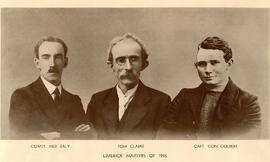
UntitledThe Daly Papers provide a unique insight into the birth of the Irish republic and the country’s search for an identity in the first decades of its existence. At the core of the collection is material relating to John Daly, a prominent Fenian and a source of inspiration to the generation that followed, as attested by the quantity of correspondence from numerous prominent republicans of the time. Of particular note is Daly’s correspondence with Thomas Clarke (P2/2/1/11/1, 3, 5 and 6; P2/2/1/18/9-21, 23-27 and 29-30). Other items of note include Seán Mac Diarmada’s account of his part in the Howth gun-running operation (P2/2/1/31/8); Edward (Ned) Daly’s last letter to his mother on the eve of the Easter Rising (P2/2/1/17/2); and Kathleen Clarke’s letters to her sisters during her imprisonment in 1918-19 (P2/2/1/10/4-10). The latter also illustrate the role of women in the formation of the Irish republic, as do several other items of correspondence in the collection. Madge Daly’s draft memoirs (P2/2/2/2/1-5) provide a first-hand account of the events leading up to and immediately following the Easter Rising. Her account of a visit to Kilmainham Jail to see her brother Edward (Ned) Daly prior to his execution (P2/2/2/3/1) offers a unique insight into the hardship suffered by the families of the leaders of the Easter Rising, and added poignancy is provided by personal effects in Ned’s possession which were returned to the family after his death (P2/4/1/3). The large volume of photographs contained in Series 6 provides further insights into the main players of this most turbulent of times.
Material relating to the Dore branch of the Daly family opens a window into the young nation’s first steps as an independent state. Of particular interest are Edward Dore’s military medals (P2/4/3/1-4) and his determination to commemorate the Easter Rising in Limerick City which resulted in the erection of a memorial on Sarsfield Bridge in 1956 (P2/2/1/60/6/2, P2/3/1/3/1/1-4, P2/5/1/41 and P2/6/8/5-9); and his son Éamonn de hÓir’s impassioned campaign for the promotion of the Irish language (P2/3/2/3/3/1-14) and his extensive contribution to the study of Irish place names (P2/3/2/3/2/1-20). Also of note is de hÓir’s substantial research into the life of John Daly (P2/3/2/3/5/1-3 and P2/5/1/61-65) with a view to writing his biography, the publication of which was prevented by de hÓir’s untimely death.
The collection of letters and artefacts in the possession of the Daly family was originally considerably more substantial but the burning of their home in 1921 by the British Army destroyed much valuable material (see P2/2/1/19/3, P2/2/1/60/3/3, P2/2/1/62/5, P2/4/1/7 and P2/5/1/40). Records relating to the Daly family’s bakery in Limerick City are superficial, comprising mainly account books from Edward Dore’s time as manager. The fate of the papers relating to this business is unknown.
UntitledThis small collection contains routine correspondence and accounts created and generated by Maxwell, Weldon & Co. on behalf of their clients, mainly pertaining to probate, death duties and other testamentary matters.
UntitledThe Coote papers comprise in the main early twentieth-century correspondence and accounts maintained by the Coote family’s land agents Guinness, Mahon & Co. and, from 1953, William Montgomery & Son Ltd. The correspondence is routine by nature and illustrates the less glamorous side of estate management involving leaky roofs and inadequate sewage pipes. There is an interesting set of deeds, the earliest of which date from the second half of the eighteenth century; a lengthy marriage settlement drawn up on the eve of the marriage of Grace Coote and the Reverend Henry Bathurst; and letters of administration relating to complications arising from the will of Charles Henry Coote whose heir and two executors all died before probate could be granted. There is also an extensive set of grazing and letting agreements from 1876 to 1953, mostly dealing with plots of ground in the vicinity of the town of Maryborough (now Portlaoise) in county Laois. Perhaps the most important item in this collection is a bound hardcover volume of hand-drawn maps of the estates of General Sir Eyre Coote (1726-1783) surveyed in 1803 by Robert Ely (P10/5/1). Each page in the book is devoted to a single townland, with a helpful index providing the name and total acreage of each townland and the name of its tenant.
UntitledThe collection items consist of seals, reproductions of portraits and transcripts of documents relating to the De Laval and Willis families, providing in snapshot detail the fate of a high-ranking Huguenot family forced into exile, their efforts to create a new life in a foreign country, and the lives of their descendants.
UntitledThe material consists of leases, mortgages, conveyances, marriage settlements and wills relating to the families of Odell (1782-1891), Morony (1831-1937), Lloyd (1829-1965) and Allott (1947-1999). Of particular interest is the copy will relating to Helen Sophia Chenevix (1890-1963), General Secretary of the Irish Women Workers’ Union (1955-1957), member of the Irish Trade Union Congress executive committee (1946-1956), and one of the first female graduates of Trinity College, Dublin (see P27/1/4/1/3/1). There are also extensive records relating to the dairy farm managed at Odellville from 1945 to 1994, including stock breeding and sales records, milk records and farm accounts (P27/2/1/2-6). There is some architectural material relating to improvements carried out at Odellville between 1880 and 1900 (P27/1/2/7/1-3). There are also 19th-century scrapbooks and other items of Quaker interest relating to the Watson and Webb families (P27/3/1/1-4).
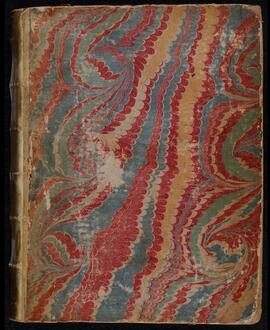
UntitledA bound manuscript compendium of statutes, orders and decrees relating to Emmanuel College, Cambridge. Covering the period 1585 to 1661, the contents reflect the physical and curricular expansion of the College during its first 75 years of existence.
The first half (folios 1-43) contains the Latin text of the College’s first statutes as provided by its founder Sir Walter Mildmay. The second part of the manuscript (folios 44-81) comprises orders and decrees primarily in English concerning such matters as the borrowing and buying of books from the college library, stipends, rent rates for chambers and rules of the use of the college tennis court. In 1630, one of the decrees ordered that no student ‘shall size bread and beer anywhere but in the Butteries, nor have Dyett provided for them constantly out of the College’ (p. 63). The onset of a plague epidemic eight years later also features prominently. Scholars and fellows of the College were permitted to ‘have free leave to betake themselves thither, where they shall be able best to provide for their own safety, and that notwithstanding the same, they shall receive in the time of their absence the allowance from the College…’ (p. 68) In 1651, misbehaving students were threatened with fines and imprisonment when it was discovered that some of them ‘not regarding their own birth, degree, and quality have made divers contracts of marriage with women of mean estate, and of no good fame in the town to their great disparagement, the discontent of their Parents and friends, and the dishonour of the government of that our University’. Students were strictly forbidden to ‘resort to such houses and places as are mentioned in the said Statute to eat or drink or play or take tobacco, to the misspending their time and to the corrupting of others by their ill example, and to the scandalizing the government of our said University.’ (pp. 71-72)
The volume is most likely from the library of William Shaw (1688-1739) of St John’s College, Cambridge, Rector of Akenham and antiquary. Among the Clarendon Papers held at the Bodleian Library are two further manuscripts from the collection of William Shaw, namely an eighteenth-century commonplace book (MS. Clar. dep. c. 413) and an eighteenth-century volume of ‘Extracts of Records &c. relating to St John’s College in the University of Cambridge’ (MS. Clar. dep. c. 414). The Emmanuel College volume has an eighteenth-century numbering on the inside front cover (No. 47). The two manuscript volumes in the Bodleian Library bear identical numbering, respectively nos. 100 and 46, placing the latter just next to our volume, also relating to a Cambridge college.
The inside cover of the volume contains the bookplate of Charlotte Villiers, Countess of Clarendon (1721-1790), formerly Lady Charlotte Capell, heiress to the wealthiest branch of the Hyde family and wife of Thomas Villiers, Baron Hyde and later 1st Earl of Clarendon (both titles acquired through his marriage). The family seat, The Grove, the name of which appears on the bookplate, was located near Watford, in Hertfordshire. It was acquired in 1753 by Thomas Villiers and turned into one of the most fashionable country homes in England.

Untitled